
Warning Lights on Your Dashboard: What Each One Is Actually Telling You

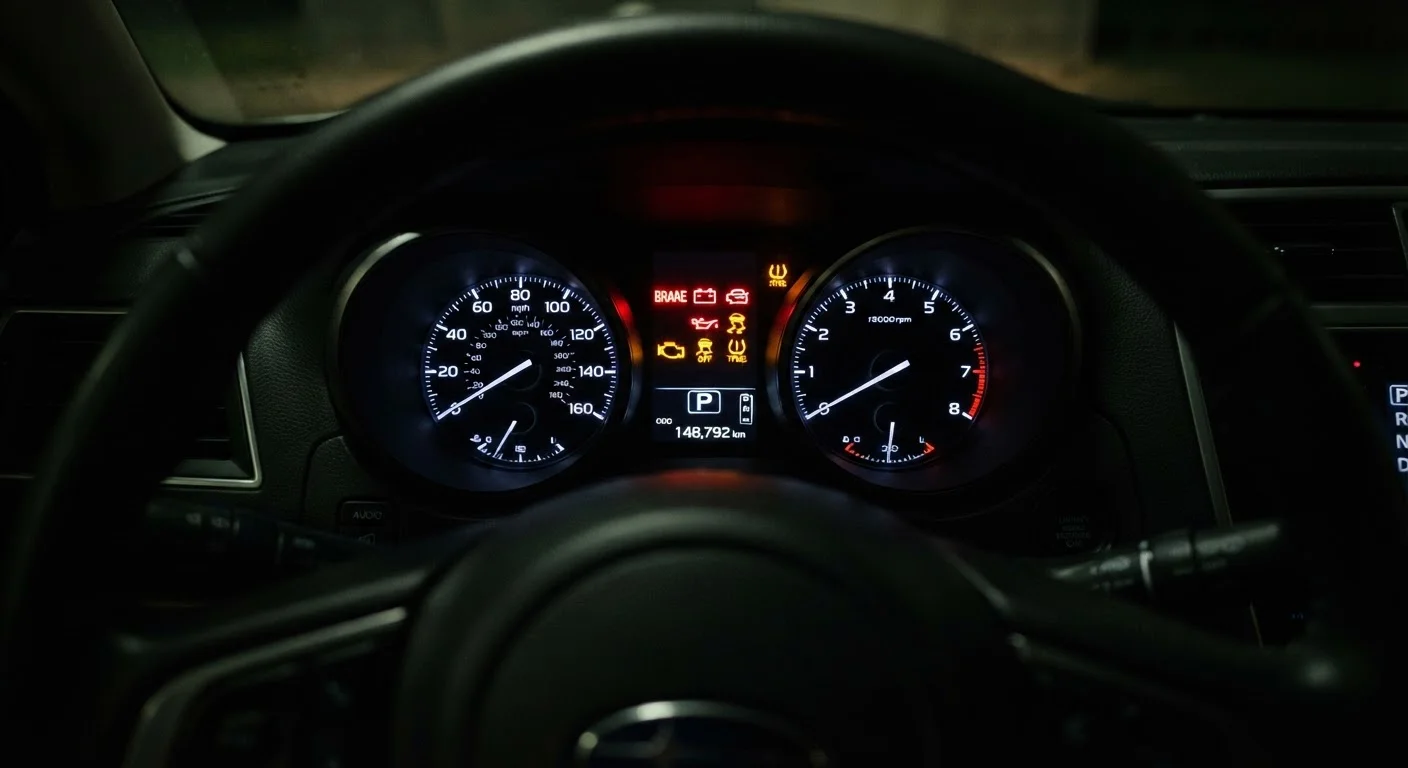
Photo: latesttrend.net editorial
How the color system works
Most modern vehicles use a three-color system to signal urgency. Red means stop or act immediately. Amber (orange or yellow) means investigate soon, but you can usually drive a short distance. Green or blue are informational, confirming that a feature is active.
A light that flashes is generally more urgent than one that stays solid. If a red light appears while you are driving, pull over safely when you can and consult your owner's manual before continuing. The manual is the single most reliable reference for your specific vehicle, because symbols vary by manufacturer.
OBD-II
On-Board Diagnostics, second generation. A standardized system built into most vehicles sold in the US after 1996 that monitors engine and emissions systems and stores fault codes when a problem is detected.
Fault code (DTC)
A Diagnostic Trouble Code stored by the OBD-II system when a sensor or component reads outside its normal range. Codes follow a standard format (e.g., P0420) that identifies the affected system.
TPMS
Tire Pressure Monitoring System. A sensor-based system required on US passenger vehicles since 2008 that alerts the driver when tire pressure drops significantly below the recommended level.
Alternator
A generator driven by the engine that charges the battery and powers the vehicle's electrical systems while the engine is running. A failed alternator causes the battery warning light to activate.
ABS
Anti-lock Braking System. A safety system that prevents wheels from locking during hard braking, helping the driver maintain steering control. An ABS fault does not eliminate basic braking function.
The lights that demand immediate attention
These red warning lights indicate conditions that can cause engine damage, loss of control, or a safety risk if you keep driving.
- Oil pressure warning: A low oil pressure reading means lubrication has dropped to a level that can destroy engine internals within minutes. Turn off the engine when safe to do so. Check the oil level once the engine has cooled. If the level is fine and the light stays on, have the car towed to a mechanic.
- Temperature warning: An engine overheating can warp cylinder heads and cause significant damage. Turn off the air conditioning, pull over, and let the engine cool before opening the hood. Do not remove the radiator cap while hot.
- Battery warning: This light usually indicates the charging system has failed, not necessarily the battery itself. The alternator may have stopped working. Drive to a shop promptly, because the car will run on battery reserve only until it dies.
- Brake warning: If the parking brake is not engaged, this light can indicate low brake fluid or a failure in the brake system. Both situations affect stopping ability. Have it inspected before driving further.
| Colors indicating urgency | Red (stop now), amber (address soon), green/blue (informational) |
| OBD-II standard applies to | Most US passenger vehicles built after 1996 (US EPA OBD-II mandate) |
| TPMS trigger threshold | 25% below recommended tire pressure (NHTSA TPMS rule (49 CFR Part 571)) |
| Flashing check engine light | Indicates active engine misfire; avoid continued driving |
| Door jamb sticker | Correct source for recommended tire pressure (not the sidewall) |
Amber lights: watch carefully but stay calm
Amber lights are not emergencies in most cases, but ignoring them often turns a small repair into a large one.
- Check engine light (CEL): This light covers a wide range of issues, from a loose gas cap to a failing catalytic converter. A steady CEL generally allows short-term driving. A flashing CEL suggests active engine misfires and warrants stopping soon to avoid catalytic converter damage, which is expensive to repair. An OBD-II scanner (available for loan at many auto parts stores) can read the stored fault code.
- Tire pressure (TPMS): One or more tires is 25 percent or more below the recommended pressure. Check all four tires with a gauge and inflate to the pressure listed on the door jamb sticker, not the number on the tire sidewall. See how tire pressure affects your fuel costs for more detail.
- Traction control / stability control: If this light flashes while you are driving in wet or slippery conditions, the system is working normally. If it stays on, the system may be disabled or faulty.
- ABS warning: The anti-lock braking system has detected a fault. Normal braking still works, but ABS may not activate in a panic stop. Avoid high-speed driving until inspected.
- Transmission temperature: Transmission fluid is overheating, often from towing or stop-and-go traffic. Pull over and let the system cool.
Fault codes and DIY diagnosis
When the check engine light appears, the vehicle's onboard diagnostics system (OBD-II) stores a fault code. Reading that code tells you which system triggered the light. OBD-II scanners range widely in price, and many auto parts retailers offer a free code-reading service. The code alone does not tell you exactly what part to replace; it identifies the system or sensor that reported an out-of-range condition.
If you have recently bought a used vehicle, those stored codes can reveal problems the previous owner ignored. Setting up a maintenance baseline when you buy used covers how to build a full picture of what your car actually needs.
Some lights reset on their own after the underlying condition clears. Others stay on until a technician clears them with a scan tool. Clearing a code without fixing the root cause will only bring the light back.
The content provided on our blog site traverses numerous categories, offering readers valuable and practical information. Readers can use the editorial team’s research and data to gain more insights into their topics of interest. However, they are requested not to treat the articles as conclusive. The website team cannot be held responsible for differences in data or inaccuracies found across other platforms. Please also note that the site might also miss out on various schemes and offers available that the readers may find more beneficial than the ones we cover.