
Bodyweight Training vs. Resistance Bands: Which Works Better on a Tight Budget?

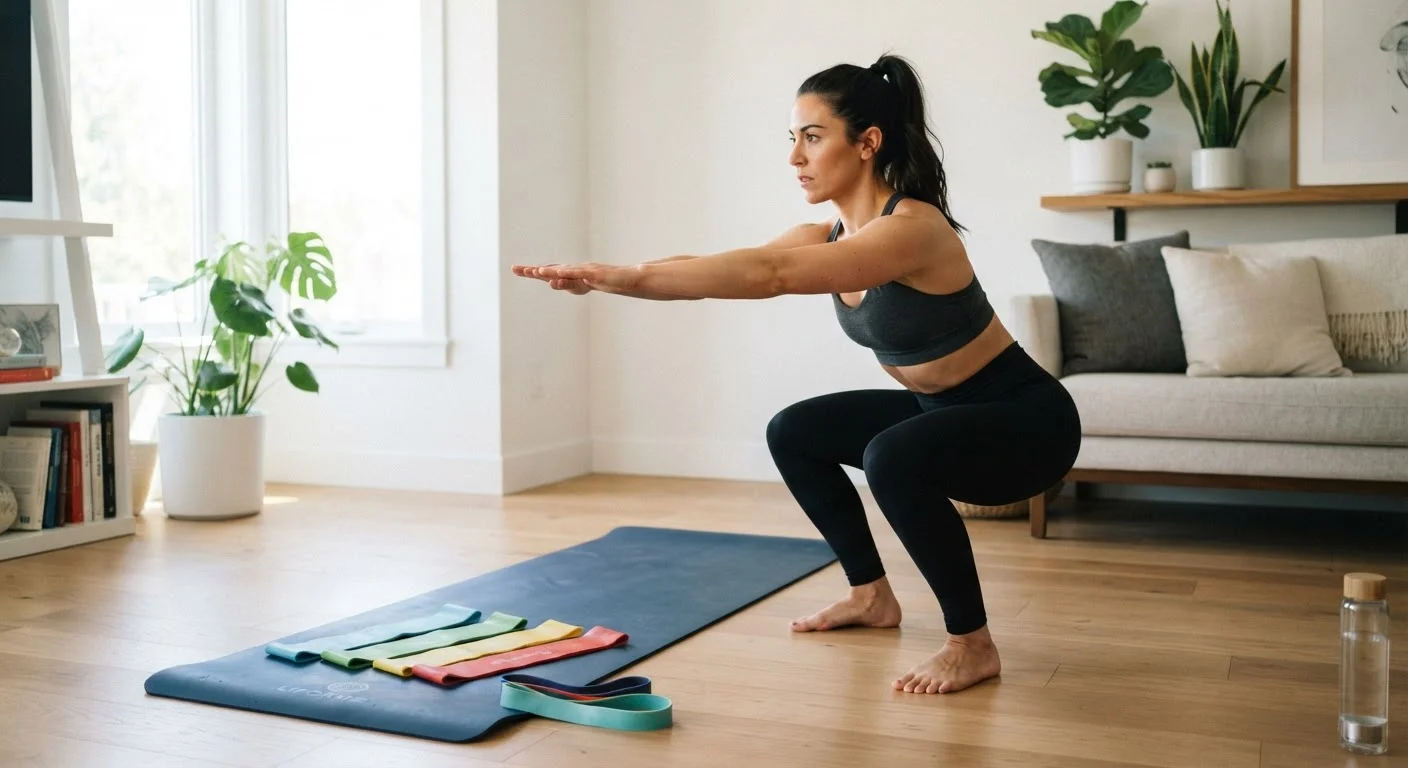
Photo: latesttrend.net editorial
Key Takeaways
- Bodyweight training costs nothing and can start today with zero equipment.
- Resistance bands typically cost between $10 and $30 for a basic set.
- Bodyweight exercises build strength and endurance using leverage and movement complexity.
- Bands allow incremental resistance increases, which supports steady progression over time.
- Both approaches are effective for general fitness when used consistently.
- Your living space, goals, and budget all influence which option fits your family better.
What each approach actually delivers
Bodyweight training uses your own mass as resistance. Exercises like push-ups, squats, glute bridges, and mountain climbers work multiple muscle groups at once and can be scaled by changing leverage, tempo, or range of motion. A push-up becomes harder when your feet are elevated. A squat becomes more demanding when you add a pause or progress to a single-leg variation. The ceiling is genuinely high for someone willing to learn movement progressions.
Resistance bands are elastic tools that create tension throughout a movement. Unlike free weights, the resistance increases as the band stretches, which means the hardest part of the movement is at full extension. This characteristic works well for exercises like rows, pull-aparts, banded squats, and lateral walks. A standard set of loop or tube bands covers a wide range of resistance levels, and most sets include light, medium, and heavy options.
For families building a routine from scratch, both approaches fit well into home or outdoor settings. See how to build a family fitness routine with no gym for practical ideas on structuring sessions around these tools.
Cost comparison: what you actually spend
Bodyweight training has no purchase cost. You need a flat surface and, for comfort, a mat (which is optional). That is the entire financial commitment.
Resistance bands carry a small upfront cost. A set of five loop bands with varying resistance typically runs $10 to $20. Tube bands with handles run slightly higher, often $15 to $30 for a full set. These are one-time purchases with no subscription, no replacement parts, and no ongoing fees. Bands do wear out over time, particularly if stored in direct sunlight or used on abrasive surfaces, but a well-maintained set can last several years.
| Criterion | Bodyweight training | Resistance bands |
|---|---|---|
| Upfront cost | $0 | $10 to $30 for a set |
| Equipment needed | None (mat optional) | Band set, door anchor optional |
| Portability | Complete, no gear required | High, fits in a small bag |
| Progression method | Movement complexity and leverage | Swap to heavier resistance band |
| Exercise variety | Wide, limited by skill level | Wide, especially upper body and hips |
| Durability | No wear, always available | Several years with proper care |
| Best for beginners | Yes, low learning curve | Yes, with basic instruction |
If your family is weighing every dollar, the real cost comparison between gyms and home workouts puts both approaches in context against monthly membership fees.
Progression and long-term effectiveness
The most common concern with bodyweight training is hitting a plateau. That concern is real but manageable. Once standard push-ups become easy, you can move to archer push-ups, decline push-ups, or eventually pseudo planche push-ups. Squats progress to Bulgarian split squats and pistol squats. The progressions exist, but learning them takes research and patience.
Bands solve the plateau problem more directly. When a band becomes too easy, you move to a heavier band. That linear progression mirrors what you would do adding weight to a barbell, without the cost or space requirement. For exercises that are hard to scale with bodyweight alone, such as rows and upper-back work, bands fill a genuine gap.
One honest limitation of bands: very heavy compound movements (deadlifts, heavy squats) are harder to replicate with bands alone as strength advances significantly. For general family fitness, however, most people do not hit that ceiling within the first year or two of consistent training.
This article is for general informational purposes only and is not medical or exercise advice. Consult a qualified fitness or healthcare professional before starting a new exercise program, especially if you have an existing health condition or injury.
Which fits your family's situation
If you have never exercised consistently before, bodyweight training removes every possible barrier. There is nothing to buy, nothing to set up, and nothing to learn about equipment. A family of four can do a 20-minute circuit in a living room tonight.
If someone in your family has specific strength goals, is returning from injury (with professional clearance), or simply gets bored without variety, a band set adds enough range to stay engaged for much longer. The $10 to $30 cost is easy to evaluate against months of use.
A combined approach works well too. Bodyweight moves for the bulk of a session, with bands added for targeted work like shoulder stability or hip strengthening. Before spending anything, it is worth reading which fitness purchases families rarely need to avoid spending on things that add less value than either of these options.
$0
Minimum cost to start bodyweight training
No equipment is required to perform foundational bodyweight exercises such as squats, push-ups, and planks.
$10-$30
Typical cost of a resistance band set
Multi-band sets covering light to heavy resistance are widely available at this price range as a one-time purchase.
Under 1 lb
Weight of a full resistance band set
A standard set of five loop bands weighs well under a pound, making it practical for travel or small living spaces.
The content provided on our blog site traverses numerous categories, offering readers valuable and practical information. Readers can use the editorial team’s research and data to gain more insights into their topics of interest. However, they are requested not to treat the articles as conclusive. The website team cannot be held responsible for differences in data or inaccuracies found across other platforms. Please also note that the site might also miss out on various schemes and offers available that the readers may find more beneficial than the ones we cover.