
Insulation Types and How They Compare for Cost, Performance, and Installation

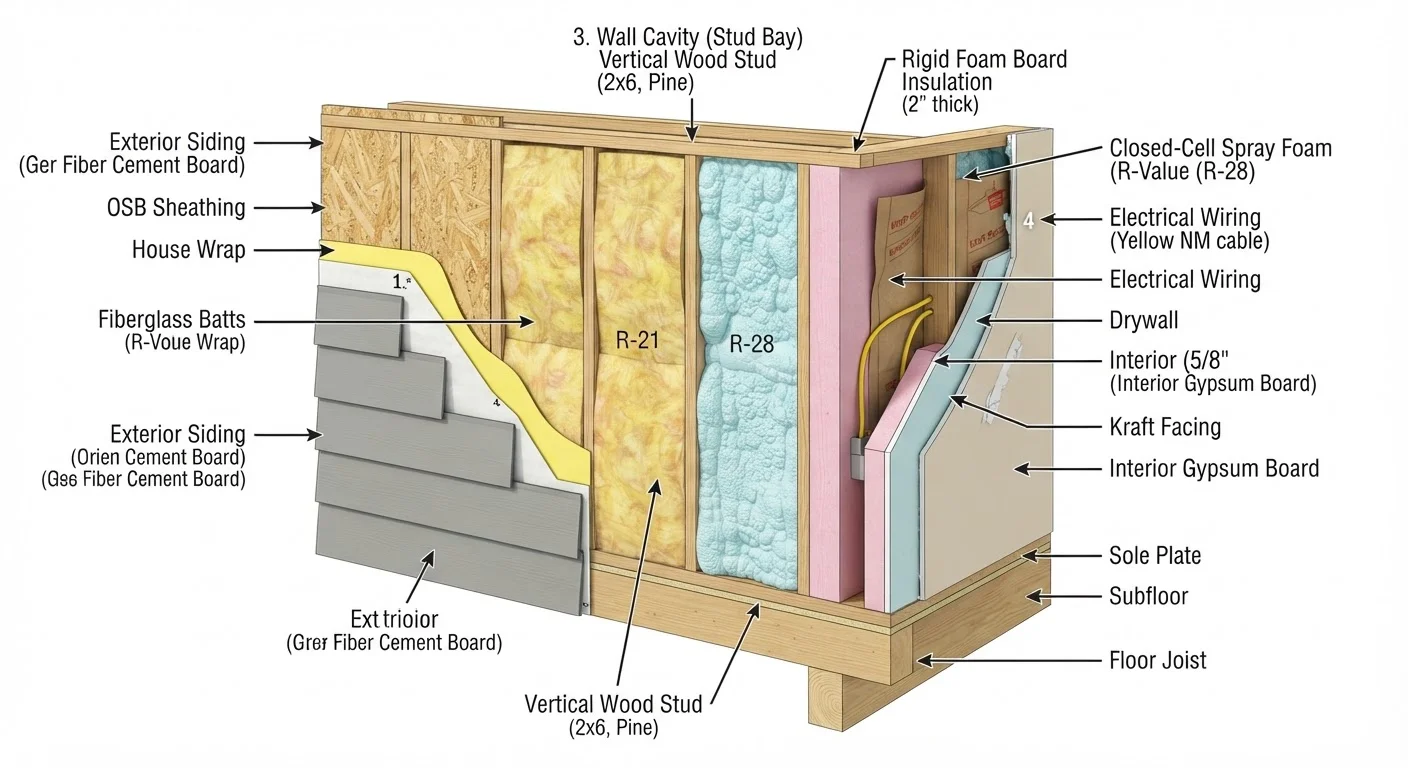
Photo: latesttrend.net editorial
Key Takeaways
- Fiberglass batts cost the least upfront and work well in standard stud cavities with no air gaps.
- Blown-in cellulose fills irregular spaces better than batts and has a lower carbon footprint.
- Spray foam provides the highest air-sealing performance but carries a significantly higher price.
- Rigid foam board works best on exterior walls, basement walls, and under slabs where batts cannot go.
- R-value alone does not tell the full story: air sealing matters as much as thermal resistance.
What R-value means and why air sealing matters too
R-value measures how well a material resists heat flow. The higher the number, the more slowly heat moves through it. The U.S. Department of Energy publishes recommended R-values by climate zone, ranging roughly from R-13 in mild southern climates to R-60 for attics in cold northern regions.
However, R-value is measured under laboratory conditions with no air movement. A wall insulated to R-19 with fiberglass batts but full of gaps and bypasses can perform closer to R-10 in practice. That gap happens because air carries heat faster than conduction through solid material. Combining good insulation with proper air sealing closes that performance gap. For a hands-on approach to finding and fixing air leaks alongside insulation work, see this guide to sealing a drafty house.
Fiberglass batts
Fiberglass batts are pre-cut panels of spun glass fiber, sold to fit standard 16-inch and 24-inch stud spacing. They are the most widely available insulation product and the least expensive per square foot. A homeowner with basic skills can install them in open wall or floor cavities without renting equipment.
The trade-offs are real. Batts must fit tightly against every surface to perform as rated. Any compression, gap, or void around wires and pipes reduces effective R-value. They provide no meaningful air sealing on their own. In humid climates, improperly installed batts can trap moisture and develop mold if vapor management is not addressed during installation.
Typical installed cost for fiberglass batts runs lower than other options, making them the default choice when walls are already open during renovation or new construction.
Blown-in cellulose
Cellulose is made from recycled paper treated with borate for fire and pest resistance. Installers blow it into place using a hose and blowing machine, which allows the material to settle around obstructions like wiring, plumbing, and irregular framing.
For attics, blown-in cellulose is a practical retrofit option because installers can add depth without tearing out drywall. It achieves roughly R-3.5 per inch. Dense-pack cellulose, blown into closed wall cavities through small holes, can also reduce air infiltration better than loose-fill fiberglass under the same conditions.
Machine rental is available at many home improvement stores for DIY attic projects, though dense-pack wall installation generally requires professional equipment and technique to achieve adequate density. Material cost is modest; labor drives the total price for professional installation.
| Fiberglass batts | Blown-in cellulose | Spray foam (closed-cell) | Rigid foam board | |
|---|---|---|---|---|
| Typical R-value per inch | R-2.9 to R-3.8 | R-3.2 to R-3.8 | R-6 to R-7 | R-3.8 to R-6.5 |
| Air sealing ability | None on its own | Moderate (dense-pack) | Excellent | Moderate with taped seams |
| Relative installed cost | Lowest | Low to moderate | Highest | Moderate |
| DIY feasibility | Yes, open cavities | Yes, attics with rental | No (small areas only) | Yes, with proper prep |
| Best application | Open wall cavities | Attic retrofits | Rim joists, crawl spaces | Basements, exterior layers |
| Moisture resistance | Low | Moderate | High (closed-cell) | High |
Spray foam
Spray polyurethane foam comes in two main types. Open-cell foam is softer and less dense, achieving about R-3.7 per inch, and allows some vapor transmission. Closed-cell foam is rigid, denser, and reaches R-6 to R-7 per inch while acting as a vapor barrier.
Both types expand to fill gaps and bond to surfaces, which provides significant air sealing alongside thermal resistance. This makes spray foam particularly useful in rim joists (the framing at the top of a foundation wall), crawl spaces, and cathedral ceiling cavities where air movement is difficult to stop otherwise.
The cost is substantially higher than other insulation types, often three to five times the installed price of fiberglass batts for the same area. Professional installation is required because the chemicals involved are hazardous during application and the mixing ratios must be precise. DIY spray foam kits exist for small areas like rim joists, but whole-house spray foam is not a realistic DIY project.
Rigid foam board
Rigid foam panels are manufactured in three main formulations: expanded polystyrene (EPS), extruded polystyrene (XPS), and polyisocyanurate (polyiso). R-values range from about R-3.8 per inch for EPS to R-6 or more per inch for polyiso, depending on temperature and age of the board.
Rigid foam works where flexible materials cannot: below a concrete slab before pouring, against a basement wall on the interior, or as a continuous layer on the exterior sheathing of a home to eliminate thermal bridging through studs. Thermal bridging occurs when framing members conduct heat around the insulation between them, reducing whole-wall performance.
Cutting and installing rigid foam is a manageable DIY task using a utility knife or circular saw. Many foam board products require a fire-rated covering (typically drywall) on the interior due to building codes. Verify local requirements before leaving foam exposed.
Choosing based on your actual situation
The right insulation depends on where you are installing it, what access you have, and what your budget allows. Open stud bays during a remodel point toward batts for cost reasons. An accessible attic with no existing insulation is a strong candidate for blown-in cellulose. Rim joists and crawl spaces, where air leakage is substantial, often justify the higher cost of spray foam because the performance gain is concentrated in a small area. Basement walls and exterior continuous insulation layers call for rigid foam board.
Before purchasing materials, check whether your local utility or state energy office offers rebates for insulation upgrades. Many programs exist that can reduce out-of-pocket costs, though availability and terms vary by location.
The content provided on our blog site traverses numerous categories, offering readers valuable and practical information. Readers can use the editorial team’s research and data to gain more insights into their topics of interest. However, they are requested not to treat the articles as conclusive. The website team cannot be held responsible for differences in data or inaccuracies found across other platforms. Please also note that the site might also miss out on various schemes and offers available that the readers may find more beneficial than the ones we cover.